Posts
Posts


Showing posts with label Applied Kinesiology. Show all posts
Showing posts with label Applied Kinesiology. Show all posts
Saturday, 13 November 2010
The College of Naturopathic Medicine (again)
Here's another installment in my continuing series of complaints against the College of Naturopathic Medicine.
When they aren't busy defending the galaxy from the clutches of the evil Lord Xenu, the College offer courses in a number of bullshit complementary therapies.

About reflexology, the college writes:
"Reflexology...helps to restore natural balance of the body resulting in an improved sense of health and well being [sic]. Energy, mood, circulation and immunity can also be enhanced. This relaxing treatment benefits many health conditions such as: stress, anxiety, insomnia, muscular pain, headaches, migraines, digestive disorders, hormonal imbalances e.g. PMS, menopause, and more..."
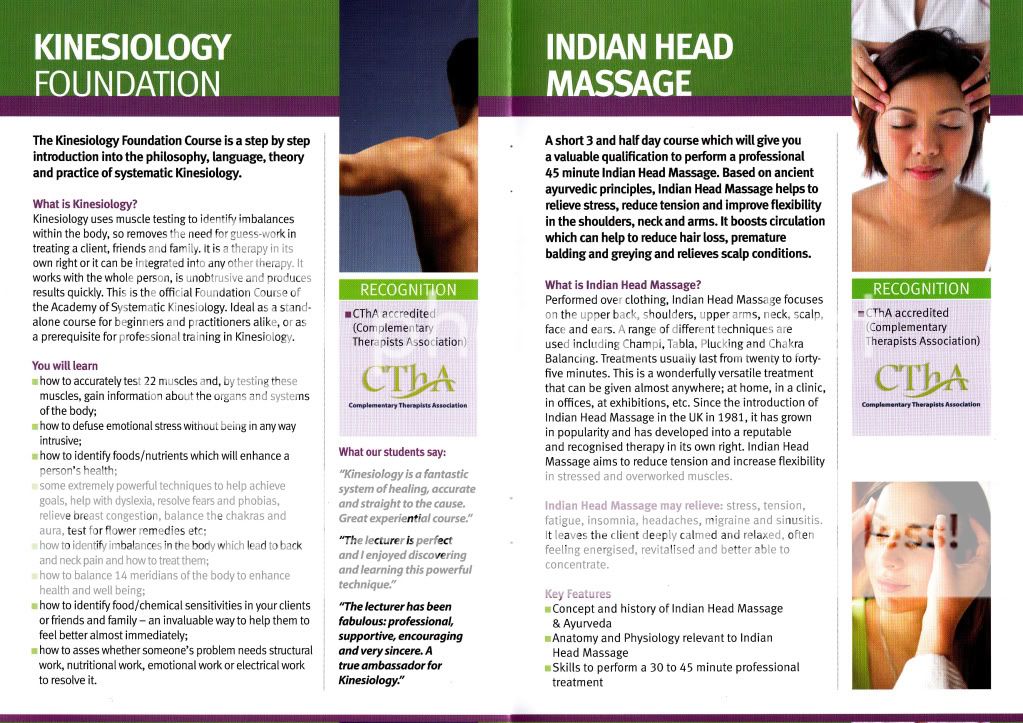
The college's booklet (available here, here, here and here) goes on to expound on the benefits of Applied Kinesiology - a subject with which my complaints have already dealt.
Can the college substantiate any of their claims? Or will they simply refer me back to p3678 of L Ron Hubbard's official memoirs (volume ninety-four)?
ASA complaint follows!
"I write to complain about a booklet I picked up at the CamExpo exhibition in London on 24th October this year.
The booklet, for the College of Naturopathic Medicine, promotes courses in a number of complementary therapies.
I suspect that the booklet may be in breach of the British Code of Advertising, Sales Promotion and Direct Marketing (CAP Code). I can provide the original booklet by post, if necessary.
1. Page 3 of the booklet contains the following text:
"Reflexology...helps to restore natural balance of the body resulting in an improved sense of health and well being [sic]. Energy, mood, circulation and immunity can also be enhanced. This relaxing treatment benefits many health conditions such as: stress, anxiety, insomnia, muscular pain, headaches, migraines, digestive disorders, hormonal imbalances e.g. PMS, menopause, and more..."
2. The UK's leading authority on complementary medicine, Professor Edzard Ernst, has recently written about the evidence base for reflexology [1]:
"Conclusion - The notion that reflexology can be used to diagnose health problems has been disproved and there is no convincing evidence that it is effective for any condition. Reflexology is expensive, and it offers nothing more than could be achieved from a simple, relaxing foot massage."
3. Therefore, under Section 12.1, I challenge whether the advertisers can substantiate their claims that reflexology can treat "stress, anxiety, insomnia, muscular pain, headaches, migraines, digestive disorders, hormonal imbalances e.g. PMS, menopause, and more" and that reflexology can enhance "circulation and immunity".
4. Page 6 of the booklet contains the following text:
"What is Kinesiology? Kinesiology uses muscles testing to identify imbalances within the body, so removes the need for guess-work in treating a client, friends and family... Kinesiology... produces results quickly."
5. The booklet continues:
"You will learn - how to accurately test 22 muscles and, by testing these muscles, gain information about the organs and systems of the body... how to identify foods/nutrients which will enhance a person's health... some extremely powerful techniques to help achieve goals, help with dyslexia, resolve fears and phobias, relieve breast congestion... how to identify imbalances in the body which lead to back and neck pain and how to treat them... how to identify food/chemical sensitivities in your clients or friends and family - an invaluable way to help them feel better almost immediately..."
6. (i) The therapy promoted by the leaflet is more usually known as "Applied Kinesiology", an invention of the American George Goodheart in 1964.
(ii) It is not to be confused with Kinesiology, a more mainstream (and regulated) medical discipline prevalent in the USA and Canada.
7. The first scientific paper on the ideomotor effect - a phenomenon in which a subject makes unconscious movements in response to certain ideas or stimuli - was published one hundred and twelve years before the invention of Applied Kinesiology [2].
8. I have found no clinical studies lending support to the booklet's contention that Applied Kinesiology can diagnose or treat medical conditions, but a great number which refute them, for example:
(i) Kenny JJ, Clemens R, Forsythe KD. Applied kinesiology unreliable for assessing nutrient status. Journal of the American Dietetic Association 88:698-704, 1988.
(ii) Triano JJ. Muscle strength testing as a diagnostic screen for supplemental nutrition therapy: a blind study. Journal of Manipulative and Physiological Therapeutics 5:179-182, 1982
(iii) Haas M and others. Muscle testing response to provocative vertebral challenge and spinal manipulation: a randomized controlled trial of construct validity. Journal of Manipulative and Physiological Therapeutics 17:141-148, 1994.
(iv) Applied kinesiology - Double-blind pilot study. Journal of Prosthetic Dentistry 45:321-323, 1981.
(v) Ludtke R and others. Test-retest-reliability and validity of the kinesiology muscle test. Complementary Therapy in Medicine 9:141-145, 2001.
(vi) Hyman R. The mischief-making of ideomotor action. by ideomotor action. The Scientific Review of Alternative Medicine, Fall-Winter issue, 1999.
9. Therefore, under Section 12.1, I challenge whether the advertisers can substantiate their claim that any of the named conditions can be diagnosed, or treated, with kinesiology.
10. I confirm I have no connections with the advertiser. I confirm I am not involved in legal proceedings with the advertiser.
Footnotes:
[1] Simon Singh, Edzard Ernst, "Trick or Treatment? Alternative Medicine on Trial", American edition 2008, p323
[2] http://www.sgipt.org/medppp/psymot/carp1852.htm
"


Saturday, 30 October 2010
The Association of Systematic (aka Bullshit) Kinesiology
The Association of Systematic Kinesiology lives by the motto "Prevention Our Shield".
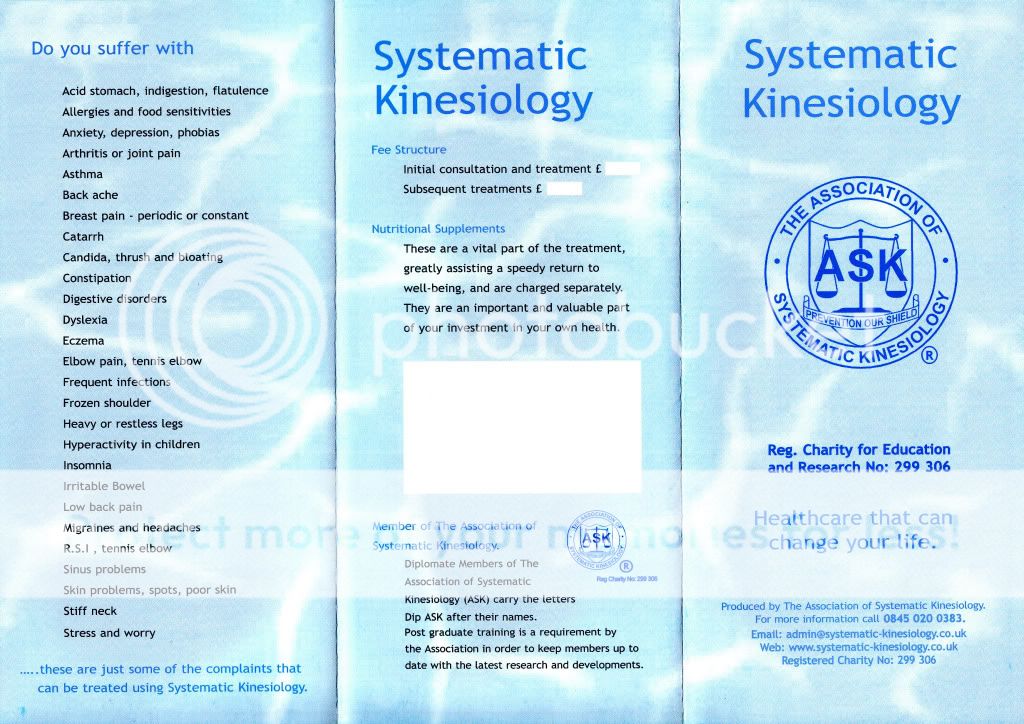
Their flyer (available here and here) does a rather fine job of shielding its readers from the truth.

Systematic Kinesiology - a sort of wibbly-wobbly twisty-turny variant of chiropractic - is more commonly known as Applied Kinesiology.
The therapy is a confused mish-mash of bogus pseudo-scientific ideas from around the world and is not to be confused with Kinesiology, an entirely different branch of mainstream medicine.
Applied Kinesiology - let's call it Bullshit Kinesiology - was invented less than fifty years ago. Amazingly, the central practice - monitoring small muscle movements in a patient - was demonstrated to be nothing but a trick of the mind a full one hundred and fifty-eight years ago!
The advertisers claim that their Bullshit Kinesiology can treat
"...flatulence... arthritis... depression... dyslexia... infections... hyperactivity ... Irritable Bowel Syndrome... migraines... Repetitive Strain Injury... spots... poor skin... "
I simply don't believe them, and in my ASA complaint I call upon a series of altogether more recent clinical studies to show why.
"I write to complain about a leaflet I picked up at the CamExpo exhibition in London on 24th October this year.
The leaflet promotes the Association of Systematic Kinesiology.
I suspect that the leaflet may be in breach of the British Code of Advertising, Sales Promotion and Direct Marketing (CAP Code). I can provide the original leaflet by post, if necessary.
1. (i) The therapy promoted by the leaflet is more usually known as "Applied Kinesiology", an invention of the American George Goodheart in 1964.
(ii) It is not to be confused with Kinesiology, a more mainstream (and regulated) medical discipline prevalant in the USA and Canada.
2. (i) The leaflet describes how the therapy is conducted:
"Kinesiology...is a way of identifying any imbalances a person has by monitoring their ability to hold their muscles against light pressure. Each muscle is related to an organ, and also to an energy pathway called a meridian...Together the muscle, organ and meridian form a 'circuit'. If there are chemical, emotional, structural or energetic stresses affecting the circuit, the muscle tested will feel 'spongy', indicating an imbalance. Once an imbalance is found the kinesiologist uses the muscle test again to get feedback..."
(ii) The leaflet continues:
"Based on this feedback the kinesiologist...[will] devise a treatment plan. It may include nutritional supplements...Bach Flower remedies, acupressure...chakra balancing...and more..."
(iii) The explanation is appended by the witticism "There is no guess work with Systematic Kinesiology".
3. The first scientific paper on the ideomotor effect - a phenomenon in which a subject makes unconscious movements in response to certain ideas or stimuli - was published one hundred and twelve years before the invention of Applied Kinesiology [1].
4. I have found no clinical studies lending support to the ideas expressed in the leaflet's explanation, but a great number which refute them, for example:
(i) Kenny JJ, Clemens R, Forsythe KD. Applied kinesiology unreliable for assessing nutrient status. Journal of the American Dietetic Association 88:698-704, 1988.
(ii) Triano JJ. Muscle strength testing as a diagnostic screen for supplemental nutrition therapy: a blind study. Journal of Manipulative and Physiological Therapeutics 5:179-182, 1982
(iii) Haas M and others. Muscle testing response to provocative vertebral challenge and spinal manipulation: a randomized controlled trial of construct validity. Journal of Manipulative and Physiological Therapeutics 17:141-148, 1994.
(iv) Applied kinesiology - Double-blind pilot study. Journal of Prosthetic Dentistry 45:321-323, 1981.
(v) Ludtke R and others. Test-retest-reliability and validity of the kinesiology muscle test. Complementary Therapy in Medicine 9:141-145, 2001.
(vi) Hyman R. The mischief-making of ideomotor action. by ideomotor action. The Scientific Review of Alternative Medicine, Fall-Winter issue, 1999.
5. Therefore, under Section 12.1, I challenge whether the advertisers can substantiate their claim that the following conditions "can be treated using Systematic Kinesiology":
(i) Acid stomach, indigestion
(ii) Flatulence
(iii) Depression
(iv) Phobias
(v) Arthritis
(vi) Asthma
(vii) Catarrh
(viii) "Candida, thrush and bloating"
(ix) Constipation
(x) Digestive disorders
(xi) Dyslexia
(xii) Eczema
(xiii) Tennis elbow
(xiv) "Frequent infections"
(xv) Restless leg syndrome
(xvi) "Hyperactivity in children"
(xvii) Insomnia
(xviii) Irritable Bowel Syndrome
(xix) Lower back pain
(xx) Migraines
(xxi) Repetitive Strain Injury
(xxii) Tennis elbow
(xxiii) Sinus problems
(xiv) "Skin problems, spots, poor skin"
(xv) (Since the leaflet claims "these are just some of the complaints that can be treated") - any other medical condition
6. I confirm I have no connections with the advertiser. I confirm I am not involved in legal proceedings with the advertiser.
Footnotes:
[1] http://www.sgipt.org/medppp/psymot/carp1852.htm
"
Subscribe to:
Posts (Atom)